

Early Years Foundation Stage (EYFS)

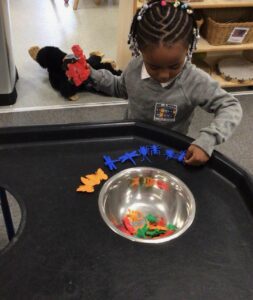


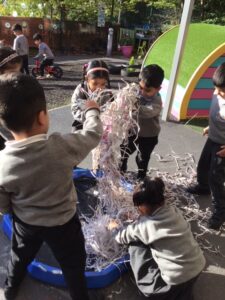

Learning in the Early Years
The EYFS at Stanley Grove consists of two Nursery classes (15 hours only) and three Reception classes.
Teaching and Learning in the Nursery and Reception classes is mainly directed by the Early Years Foundation Stage Framework (Development Matters). This provides a framework for all practitioners working with children from birth to five years old and offers guidance on providing the best quality care and education for young children.
“Children have a right, spelled out in the United Nations Convention on the Rights of the Child, to provision which enables them to develop their personalities, talents and abilities irrespective of ethnicity, culture or religion, home language, family background, learning difficulties, disabilities or gender” (Development Matters 2012)
Our curriculum is designed to promote the characteristics of effective learning which are:
| Playing and exploring – Engagement | Active learning- Motivation | Creating and thinking critically – Thinking |
| Finding and exploring Playing with what the know Being willing ‘to have a go’ | Being involved and concentrating Keeping trying Enjoying achieving what they have set out to do | Having their own ideas Making links Choosing ways to do things |
In addition, it covers the seven Areas of Learning which are divided into three Prime Areas and four Specific Areas listed below.
| Prime Areas | Specific Areas |
| Communication and Language Physical Development Personal, Social and Emotional Development | Literacy Mathematics Understanding the World Expressive Arts and Design |
We ensure that there is a balance of adult-led and child-initiated activities across the day. We strongly believe that during the child-initiated activities the adult role and their interaction with children is essential in developing new learning. The adult role is to observe, model, demonstrate, question and intervene (where appropriate) to help children develop a solid foundation of learning. Direct teaching happens throughout the day either as a whole class or in small groups.
Play Based Learning
Here at Stanley Grove, we believe that play-based learning is an important and integral part of our curriculum. We believe that children learn best from activities and experiences that interest them. Our EYFS curriculum consists of a range of cross-curricular units reflecting the needs and interests of our children at Stanley Grove.
Each unit title provides a theme e.g. Family and Community, and the unit itself provides a variety of opportunities for children to revisit and extend their prior learning, including vocabulary, and develop new skills and thinking. The learning environment reflects the seven areas of learning, and it is carefully planned and adapted for each unit to provide opportunities to extend, practise and apply the knowledge and skills the children have been introduced to.
Our Reception classes and our Nursery classes run as two separate units.
Assessment
In the first 6 weeks of the academic year, baselines are completed for all children. Staff use adult interaction and observations to carryout these assessments. These assessments are collated and put into the school’s tracking tool (Interactive Learning Diary). Throughout each week, adults will be carrying out formative assessments of children and adapting their teaching and resources accordingly. Once a term, each child is selected as the focus for a more in-depth assessment. Summative assessment judgements are made at the end of each term. This allows staff to track each child individually and measure their progress over time. Children are also assessed on entry using the Wellcomm Assessment tool, which measures communication and language skills. Those children who are receiving support for their communication and language get reassessed regularly. In Reception, staff also use Little Wandle Assessment Tracker record and analyse progress in Phonics.
Class Dojo
In 2020 we changed the way we do learning journeys and we now use ClassDojo as a platform to share learning and experiences with our parents and carers, giving them immediate access to evidence of their child’s learning.
The Role of the Adult in Early Years
‘Teaching should not be taken to imply a ‘top down’ or formal way of working. It is a broad term which covers the many different ways in which adults help young children learn. It includes their interactions with children during planned and child-initiated play and activities: communicating and modelling language, showing, explaining, demonstrating, exploring ideas, encouraging, questioning, recalling, providing a narrative for what they are doing, facilitating and setting challenges. It takes account of the equipment they provide and the attention to the physical environment as well as the structure and routines of the day that establish expectations. Integral to teaching is how practitioners assess what children know, understand and can do as well as take account of their interests and dispositions to learning (characteristics of effective learning), and use this information to plan children’s next steps in learning and monitor their progress’
Teaching and play in the early years – a balancing act? 14 July 2015
Adults enhance the children’s play in different roles. The two main roles are the play champion and the adult in focused play. The play champion can support children with self help skills, enhancements and following their own ideas in the classroom indoor and out. The adult in focused play has a role that has milestones or specific skills in mind. This might be open ended, where they support the use of all provision in the area following the children’s lead, eg accessing tools and materials in the creative area, or more specific, for example combining small world and block play linked to a text or important event.
Play Champions
Play Champions wear a pink jacket so all staff and children are aware of who can help them during continuous provision. The play champion’s role is to ensure the safety of children whilst using the different areas, modelling specific activities and engaging in purposeful play. This system also allows adults who are working 1:1 or with small groups to not be disturbed.
The Learning Environment
Continuous provision (the areas and resources children use in their free play) is linked to the needs and interests of the children in our setting. It provides familiar areas for them to explore so, for the most part, our continuous provision areas stay the same, enhancing as children’s learning progresses.
Provision can be enhanced in a variety of ways:
- Children’s interest
- Theme or topic
- Skill (such as joining, printing, cutting etc)
- Basic Skills (elements of Literacy and Numeracy)
- Direct challenge
The way we resource our areas of provision clearly shows the progressions of skills from Nursery to Reception. As seen below in an example from the sand play resources.


Working Walls and Proud Walls
The Working Wall in each unit shows the journey of the half term. This includes children’s art work, photographs, writing, models etc. All work is annotated with children’s comments and a summary of the learning that has taken place. At the end of the half term, this work is then transferred to our learning journey scrap book. Each classroom has a Proud Wall which celebrates the individual learning and progress of each child. Each child’s proud wall is unique to them and their progress. Corridor displays reflect learning that has happened over the previous half term through the theme, such as ‘The Little Red Hen’, and also provision-based activities.


Common Play Behaviours
Common play behaviours are the skills/equipment we might see children use in the different areas during continuous provision.
- They are skills the children do in that area without an adult present
- We then need to think about what we want to put into our areas to challenge that play behaviour.
- We also need to think about levelling that skill so that a range of children can access that skill at their developmental level.
We have decided to show the progression of skills through continuous provision in our setting, from Nursery to Reception.
‘The EYFS is about how children learn, as well as what they learn. Children need opportunities to develop their own play and independent exploration. This is enjoyable and motivating’ Development Matters 2021
Our Curriculum
Communication
Communication and language is a key part of our curriculum and is essential for our children.
Adults are a key part of ensuring children are developing these skills at every opportunity. Staff ensure ELKLAN strategies are used throughout the day promoting listening and attention, language and understanding skills. Staff monitor their environment to assess areas being used for social interactions and conversations.
‘Communication is an essential part of everyday life. It is also a fundamental human right. It is our primary means of accessing and conveying information and expressing our needs and wants. It is how we explain our thoughts and emotions and interpret those of others, make choices, express feelings and build relationships. It forms the basis of how we interact socially with others.’ Promoting Learning and Positive Behaviour in the Home developed by the NCSE Behaviour Practitioner team.
At Stanley Grove we support the total communication approach. This means that we use and accept all types of communication, not just speech. This approach includes facial expression, body language, gesture, sign, sounds, symbols, written language, pictures, objects of reference and electronic aids
Some of the ways we may do this in EYFS is:
- Using Gestures and signs
- Using objectives of reference
- Using Pictures and Picture exchange (PEC’s)
- Using choice boards
- Now and Next Boards
- Visual timetable
“The development of children’s spoken language underpins all seven areas of learning and development. Children’s back-and-forth interactions from an early age form the foundations for language and cognitive development” EYFS Statutory Framework 2020

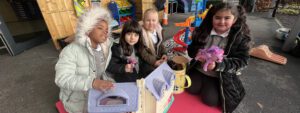

Literacy in Nursery
Literacy is taught using a planned selection of fiction and non fiction books, with a strong emphasis on vocabulary. These lessons start our day, often with an activity or ‘hook’ in the classroom to promote interest and discussion with a new theme.
We are flexible with full class, half class or small groups, depending on the length of the text. They are used as a prompt for Drawing club, which focusses on teaching the drawing and mark making about a character or key picture in a book. This is being developed from small groups in Autumn / Spring through to full class sessions in Summer to encourage a love of drawing and early writing. We have daily story times with books linked to the theme that children choose, and a ‘story bell’ story time in provision. 1-1 or 2 story times with a focus on concepts of print and discussion are planned in a quiet room from the Autumn term, and in groups in the Spring. In the Summer term, we start to use Little Wandle books where all children can have a copy of the same book. Phonics lessons develop to provide teaching of all Aspects 1-7, through routine and Music sessions in Autumn, in small groups from the Spring term and in both small groups and full class short sessions in the Summer term. The Little Wandle scheme is being introduced to develop consistency in language, and links to rhyme and texts.
Phonics
Nursery:
- Little Wandle Foundations programme is adapted for both whole class and small group delivery throughout the week.
- Opportunities are provided throughout the day, to reinforce and practise oral blending and segmenting, eg. “come and s-i-t sit on the m-a-t mat”, ‘you may leave the carpet when I say your name, a-b-d-u-l, f-i-z-a etc.”
Reception
- A daily discreet 30-minute lesson following Little Wandle year group plan.
- ‘Keep up not catch up’ – all children are included in the daily whole class lesson – magnetic boards and letters may be used by children with limited pencil control – children may work in smaller groups with an additional adult during the ‘practise’ and ‘apply’ section of the daily lesson to practise and apply blending and segmenting of words that are matched to their known PGCs.
- Additional ‘Little Wandle Keep Up’ daily sessions for children at risk of falling behind
Reading
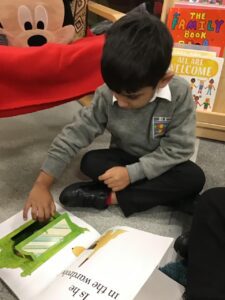
To support firm foundations in literacy, high-quality, age-appropriate modern and traditional fiction and non-fiction books are identified on the EYFS long-term plan. These books are read and re-read to the children at different times of the day. Some of the books are also used as stimuli for literacy lessons. The carefully planned list of literature ensures that all children are exposed to and become familiar with a wide range of books and stories, avoiding unnecessary repetition and ensuring increase in challenge from the beginning of Nursery to the end of Reception.
Shared reading takes place daily where the teacher shares a book with the children and talks about the features of a book ie front cover, title, making predictions and models concepts about print such as left to right tracking and return sweep. Throughout the week/s this develops into a discussion about character, settings etc. The EYFS guidance curriculum is followed by moving through the age bands.
In Guided Reading children read Little Wandle Big Cat books linked to their current phonics teaching in small groups and this enables them to apply their new learning and to practise reading words in context and a teaching sequence is followed. Every child is supported independently during every session.
Staff listen to individual children read at least once a week and change the child’s book. In Reception, children take a 100% phonically decodable book for reading at home, linked to their current learning in phonics, and a Little Wandle homework sheet, which covers the learning that has taken place that week. They can also choose a book of their choice to take home and share with their parents. In Nursery, children are encouraged to take a book home from the books box containing story books that they can share with their family.
Story Time takes place daily where the adult reads a story to the children and the children relax and enjoy listening.
Writing
Children use their phoneme knowledge and the skill of segmenting to write words in ways that match their spoken sounds. They also learn to spell and write some irregular common words. Children begin by writing words, sometimes as lists and labels, and they then write phrases and eventually write simple sentences which can be read and understood by themselves and others. The children’s writing often consists of a mixture of words spelt correctly and words spelt in a phonetically plausible way.
Typical behaviours that relate to handwriting for this learning goal:
- Uses some clearly identifiable letters to communicate meaning, representing some sounds correctly and in sequence
- Write own name and other things such as labels and captions
- Attempt to write short sentences in meaningful context
- Use a pencil and hold it effectively to form recognisable letters, most of which are formed correctly.
In Reception every child has a writing book. Children begin their writing journey when they are considered to be developmentally ready.


Handwriting
The ‘Penpals’ handwriting programme is followed throughout school and involves the use of digital resources to enable modelling and interactive learning. In EYFS, the focus is on readiness for handwriting, and gross and fine motor skills leading to letter formation (EYFS). The adults always model good handwriting and that handwriting is actively taught. The Penpals programme for EYFS is as follows:
• Nursery – ‘Foundation 1’ to develop children’s large and small gross motor skills. These are delivered through provision.
• Reception – ‘Foundation 2’ teaching children to write letter families in Autumn 2, Each week Reception complete the unit practically as a whole class as well as practicing independently in their workbook.
Whether jotting down a shopping list, writing a birthday card, taking down a phone message or completing a form, handwriting is an essential part of Stanley Grove children’s life. Good handwriting remains fundamental to our children’s educational achievement and the Penpals programme supports us in teaching the children to develop fast, fluent, legible handwriting. It also follows the guidelines within EYFS National Framework. Using Penpals ensures a coherent whole-school approach to driving up handwriting standards
Mathematics
The NCTEM Mastering Number curriculum teaches children a deep understanding of number. They develop fluency and ‘unmber sense’ through the delivery of a daily teacher led session. Concepts are supported through enhancements to provision. We also use the ‘White Rose’ curriculum to support the teaching of other mathematical concepts such as space, shape and measure.
In Nursery, the teaching of Maths changes through the year as our children’s communication, attention and listening skills develop.
In the Autumn term we teach through full class songs, small group work out of class and 1-1 play throughout the classroom. Maths lessons are short and active, with number songs, dances and invitations to play afterwards with enhancements linked to milestones. In the Spring term we continue with short number song sessions, and then also teach larger groups during lessons. By Summer all children are joining in with whole class sessions.
Learning outdoors
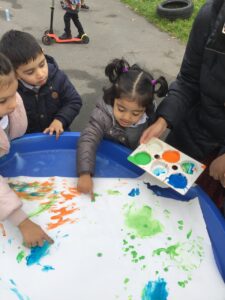
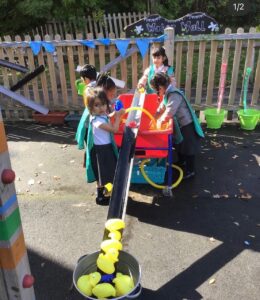
We have been working to make our outdoor provision BIGGER, MESSIER and LOUDER! This video shows some of the activities children have enjoyed whilst exploring outdoors.
|
|
Skill Plan for Week 1
|
|
|
PD Progression EYFS
|
|
|
EAD Progression EYFS
|
|
|
EYFS Year 1 Bridging Document PSED
|
|
|
EYFS Year 1 Bridging Document Art
|
|
|
EYFS Year 1 Bridging Document Reading
|
|
|
CLL Progression EYFS
|
|
|
Reception Long Term Plan
|
|
|
Nursery Long Term Plan
|





Parry Road, Longsight
Manchester M12 4NL
Call us: 0161 224 9495
Link takes you to our Twitter page @StanleyGrovePA

